Chef's knife, santoku, or perhaps a Dutch knife? Serrated or smooth? Are you also wondering how to navigate the sheer number of knives available on the market?! Don't fret, we're coming to the rescue and will try to explain in a simple way to every home chef what's what, and how to cut it!
Hold on, how many knives are there?!
If you think knives are only divided into sharp and blunt, then we must strongly object! For some time now, the culinary accessories market has been developing incredibly quickly, and currently, there are knives available for practically everything.
If you don't believe us, allow us to throw in a few examples:
dessert knife, bun knife, carving knife, bread knife, butter knife, cake knife, meat slicing and serving knife, filleting knife, foie gras knife, fish knife, cold cuts knife, hard cheese splitting knife, citrus peeling knife, utility knife, chef's knife, fruit and vegetable knife, cheese knife, slicing knife, spreading knife, boning knife, Japanese santoku, dough knife, string knife, gyuto, self-sharpening knife, oyster knife, pizza knife, truffle knife, chopping knife
and... for perfect murders (alright, we got a bit carried away there!)
Of course, we're not suggesting you move to a bigger house just to fit all these knives in your kitchen. Instead, we'll focus in our magazine on the most popular, versatile ones that will come in handy in every kitchen!

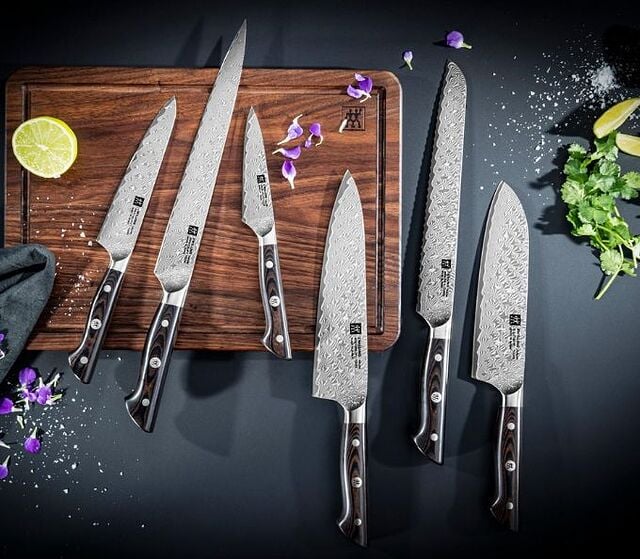


The universal knife isn't afraid of any mission
The universal knife is also known as a kitchen knife, multi-purpose knife, or... simply 'the knife' due to its popularity ;)
These knives are designed to enable efficient and quick cutting of various food products – from vegetables, through cheeses, to meats. Hence their versatility. As these are the tools we reach for most often in the kitchen, they must be ergonomic, with a comfortable handle and medium size (the blade is usually about 16 centimetres), so that neither a woman's nor a man's hand gets tired during use.
This knife is smaller and narrower than a chef's knife (which we'll get to in a moment), so it's perfect for more precise tasks, such as preparing ingredients, carving, or decorating.
These knives are usually made of stainless steel, making them durable, easy to keep clean, resistant to corrosion, and will serve you for a long time.


Chef's knife
Do you also watch cooking shows and admire professionals who slice a tonne of carrots into wafer-thin pieces in a flash, then switch the knife to the other hand and conjure up a swan shape from a watermelon? Well, we have good news for you! You too can become such a chef! Alright, maybe not exactly like that, but at least you'll have a knife like real chefs, and that's a good start!
How to recognise a chef's knife?
First and foremost, by its shape! The knife has a triangular shape, with a wide blade near the handle that tapers towards the top. Thanks to this design, it can be used for slicing dishes, shredding, chopping, crushing, and sliding food from the board into a pan or pot.
Another characteristic feature of chef's knives is the blade length. Usually no less than 20 centimetres, longer variants are typically reserved for true professionals. Shorter blades, on the other hand, are suitable for smaller hands.
A good chef's knife is also well-balanced and fits perfectly in the hand, so it doesn't strain the working hand.
These knives are usually made of stainless steel and alloys. For example, carbon steel (or high-carbon steel) knives retain their sharpness for a long time, are hard, and easy to sharpen if needed. But they can also chip more easily.
That's why proper care for these knives is so important – they must be treated with tenderness and attention, many of them should be washed by hand (unfortunately, the dishwasher is out!) and thoroughly dried after their bath. Otherwise, discolouration and stains may appear on their surface.
It's also worth considering more delicate ceramic knives, which are lighter, thinner, and resistant to abrasion, but also more brittle. Well, you can't have your cake and eat it too.


Fruit and vegetable knife
Vegetables and fruits are the basis of healthy eating, every dietitian will tell us that. So, if your argument for eating only pizza and instant noodles was "oh well, I don't have a good knife for all these vegetables and fruits", then we must disappoint you – because such knives exist and are doing splendidly!
Alright, but what does such a knife look like?
We're here with the answer! Such knives are usually short, light, handy, and of course, sharp enough to tackle even the toughest fruit skin and rebellious carrot. So, if you come across a small knife with a pointed tip, it's probably the knife we're talking about!
If you're looking for a knife to process larger, hard, or longer vegetables, you can opt for a classic, straight blade.
If, however, you're looking for a slayer of vegetable skins, fruits that are hard on the outside but soft on the inside, then consider a serrated knife.
There are also slightly rounded blades that will handle round fruits well. For more advanced chefs, we also recommend knives that resemble a cleaver
and will precisely and quickly slice everything into thin pieces.
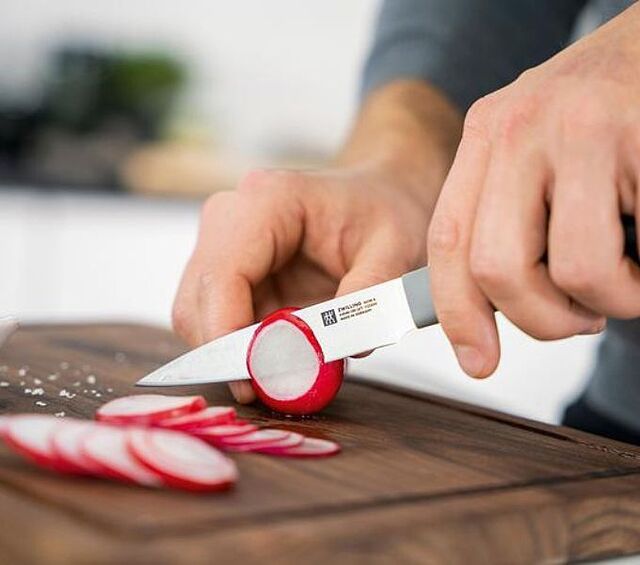


$45.20
Twin Grip Universal knife and a vegetable and fruit knife peeler
Zwilling
Dispatch within 45 working days

Meat, steak, and fish knife
If you're not a vegetarian, then such a knife should be in your 'must-have' set.
Meat knives are usually equipped with wide blades, quite substantial and durable, to tackle any, even the most stubborn, piece of meat.
Meanwhile, steak knives are handy tools about 12 centimetres long with an arched and sharply pointed blade, which makes cutting steaks easier. It's also a remnant of olden times when only knives were used for steaks, and after cutting, the steak was skewered on the blade and eaten. Who needs forks? Steak knives also usually have serrations so as not to tear the meat.
On the other hand, a cold cuts knife is a slightly different story – here, a long and narrow blade is key, allowing you to smoothly slice cold cuts into even and thin pieces.
It's also worth mentioning a boning knife (i.e., for removing unnecessary and inedible parts of meat). Such knives typically feature blades about 14 cm long, which taper towards the end, to efficiently separate meat from bones, e.g., chicken.
A fish filleting knife, in turn, can be recognised by its usually slightly upturned tip
and a relatively flexible and pliable blade.
All our meat and steak knives are here.
All fish knives are here.
And if you have the soul of a chef and want to prepare meat yourself, then be sure to read our magazine "Succulent Steaks and Roasts - How to Perfectly Prepare Meat"


Bread knives
Lack of a proper bread knife can be quite frustrating when trying, for example, to slice a soft, fluffy roll. Especially when you're sleepy in the morning and haven't had your invigorating coffee yet (by the way, read our magazine "A Small Black... Coffee" with your coffee).
Generally, it's better to trust the professionals, i.e., bread knives. These are characterised by long, serrated blades. Thanks to this, they cut through any type of bread effortlessly, like a saw, and no baguette or rye roll will stand in their way.


Cheese knife
It might seem that the topic is simple. After all, cheese is cheese. But oh, what a mistake that would be! Ever since every supermarket has at least a few fridges full of cheeses, it's not so easy to get a handle on the subject. But, but! What we really need to remember is whether the cheese is soft, semi-hard, or hard.
For soft cheeses, sharp, perforated blades work well, so the cheese doesn't stick, and with a forked end that also doubles as a fork.
For semi-hard and hard cheeses, it's worth trying flat knives that can be easily pressed against the cheese. Knives that look like a spatula or a chisel also work well, easily splitting the hard structure and dividing the cheese into smaller pieces.
All our cheese knives are here.


The mysterious Santoku knife
And finally, the cherry on top: the Japanese Santoku knife, which is gaining increasing popularity in European kitchens. Quite rightly so!
How to recognise a Santoku?
A Santoku is a knife that usually has a blade from 14 to 18 centimetres and a specific shape that somewhat resembles a chef's knife and somewhat a small cleaver. Its great advantage is its versatility – it can cut fish and meat, but also effortlessly chop vegetables and fruits. Some models also have specific indentations on the blade, which prevent food products from sticking and make cutting easier.
Of course, with a Santoku, we don't have to limit ourselves to Japanese cuisine, although it will work perfectly for cutting sushi.


On the edge!