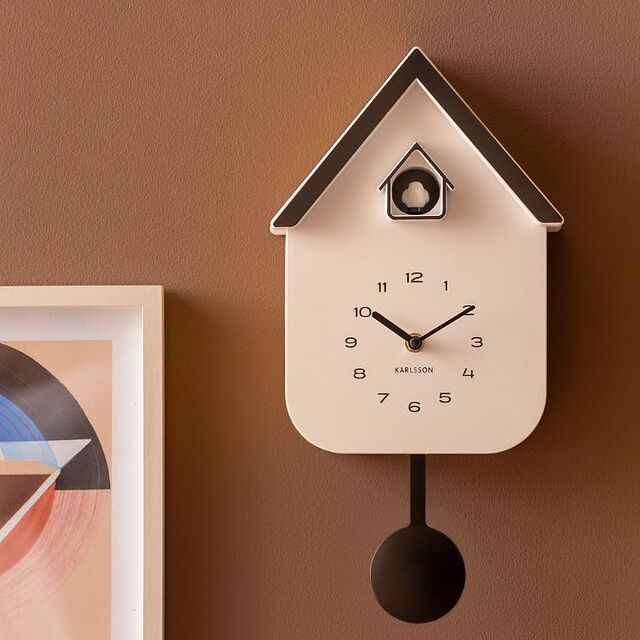
A guide for those looking for a cuckoo clock - stylish, but with a pinch of nostalgia. Here you will find answers to the most important questions, interesting facts, and our top 5 most interesting models of wall cuckoo clocks, thanks to which you will definitely not forget what time it is! For the kitchen, living room, or hallway. Welcome!
The characteristic call of the cuckoo on the hour is a sound that, for many, is associated with childhood and home warmth. Today, the cuckoo clock is making a comeback – not as a relic of the past, but as a stylish interior element combining tradition with modern design.
What is a cuckoo clock and how does it work?
A cuckoo clock is a traditional wall clock in which, on the hour, a cuckoo figure pops out of a small house (although below we prove that it doesn't necessarily have to be a bird!) and makes its characteristic "cuckoo" sound. The cuckoo calls every half hour and on every full hour, marking time in a way that engages not only sight but also hearing.
Why are these types of clocks called cuckoo clocks and what is the history of this design?
The name comes directly from the bird – the cuckoo, of course, but where did this idea and motif come from, and why did the cuckoo, with its characteristic call, become the inspiration for the creators of this type of clock?
The history of traditional cuckoo clocks - the old clock from the Black Forest
The first clocks of this type were created in the 18th century in the Black Forest in Germany, where the cuckoo was well known as a symbol of the forest and nature. Clocks had been produced in this region since the 17th century, and traditional craftsmanship techniques were passed down from generation to generation. Clockmakers reached for its voice as a natural, recognizable sound signal – and so the name stuck for good in all European languages. Black Forest products are known for their handcrafting and rich decorations, and their development on a larger scale only came with time.
The first cuckoo clocks and a motif known worldwide
The first mechanical cuckoo clocks were created in this region around 1730, and regular production began in the mid-18th century. The first cuckoo clocks were equipped with a single hand and had a mechanism based entirely on wood.
Many of them were made of wood and decorated with hand-carved elements: hunting, floral, and animal motifs, which emphasized the artisanal character and the cuckoo motif present in the decoration. Some specimens to this day have a mechanism with weights in the traditional shape of fir cones suspended on chains; such cones need to be regularly pulled up, which is part of their charm. Original models were often made of linden wood, valued for the durability of the carvings.
Cuckoo clocks have always combined utility with a decorative role and were, and still are, often treated as a souvenir or an interior design element. They come in various styles, although the rustic trend with rich decoration, often including carved rifles and antlers, dominates classic models.
Modern cuckoo clocks often adopt a minimalist design, with a limited amount of decoration, reflecting contemporary trends in interior design.
Why is it worth buying a cuckoo clock for your home?
An old cuckoo clock from childhood is a memory that can be recreated today in a modern form. Cuckoo clocks combine precise mechanics with a nostalgic element rooted in folk art and craft, making them unique compared to ordinary wall clocks.
Main benefits of having a cuckoo clock at home:
- Interior decoration – original clocks serve as a focal point in the living room, hallway, or kitchen
- Practicality – clear reading of the hands on the clock face plus an audible time signal notifies users of the hour without having to check their phone
- Emotional aspect – the sound evokes memories of an old clock from childhood and builds a cozy home atmosphere
- Variety of styles – various models are available - from traditional wooden models to minimalist metal constructions
Cuckoo clocks are valued worldwide both as a housewarming, wedding, or anniversary gift, just like other wall clocks in various styles. If you are looking for another clock for your living room or don't know if a wall cuckoo clock is a good choice, check out our living room wall clock selection guide here.


What to look for when choosing a cuckoo clock?
Before buying, it is worth considering several key criteria that will help you choose the perfect model.
Type of mechanism:
Cuckoo clocks can be powered mechanically or by quartz. The most classic mechanism is the weight-driven mechanism, which uses gravity to power the clock. Traditional cuckoo clocks are divided into one-day and eight-day models. In practice, one-day models are wound more often, and eight-day models less frequently, and pulling up the mechanism itself usually takes only a few seconds. Quartz mechanisms are easier to use because they do not require regular winding.
Sound and its adjustment:
Modern models offer a light sensor (automatic night-time silencing), an on/off switch, and volume control. The act of precise cuckooing no longer has to disturb the household members.
Style and materials:
The style of the clock should match the style of the interior. If your home is decorated in a rustic style or you are looking for a timepiece for a country house, choose a classic design. If you are looking for something more modern, and at the same time need an original clock that combines tradition with design, choose from clocks by modern brands, often produced in the Netherlands (Karlsson, NeXtime) or Japan (Lemnos).
What is special about cuckoo clocks?
Cuckoo clocks stand out primarily due to their sound mechanism – every hour (or half hour), a cuckoo figure comes out of an opening door or "hollow" and makes a characteristic two-tone sound corresponding to the number of hours. It is a strong accent in the interior and a reminder of passing time.


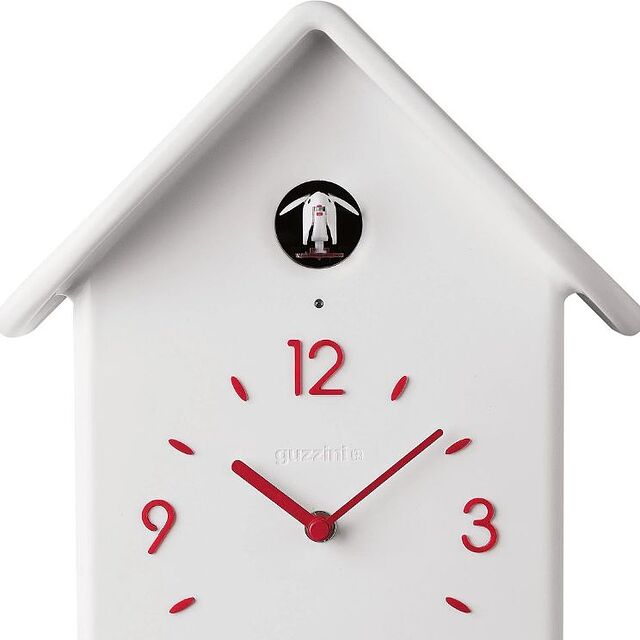
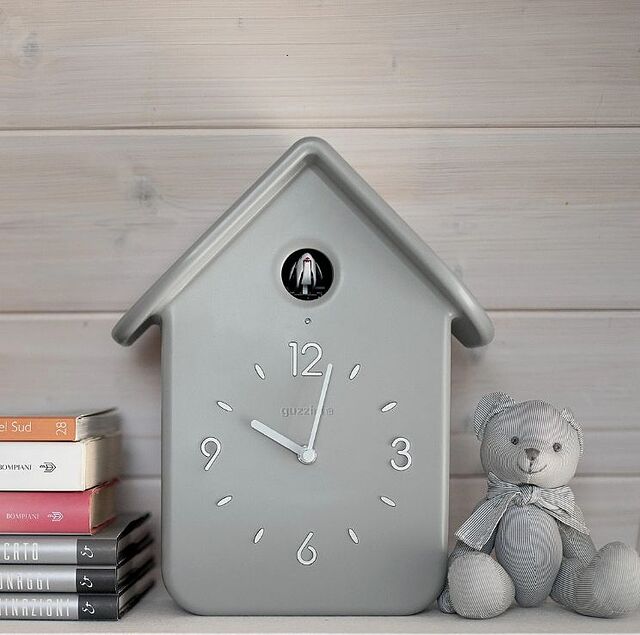
1. Colorful QQ cuckoo clock by Guzzini
An Italian interpretation of tradition in intense colors. The QQ model from Guzzini was designed by the current designers of the Brogliato & Traverso duo, winners of the Red Dot Design Award and Good Design Award, drawing inspiration from Venetian Murano glass and Japanese minimalism.
Advantages:
- The cuckoo chirps every hour with a cheerful sound
- Light sensor that silences the clock at night
- On/off switch for full control
- Pendulum acting as a second hand (removable)
- ABS plastic – durable and easy to clean
Ideal as a kitchen clock, for the dining room, and as a children's room clock. The possibility of placing it on a shelf adds creativity to the arrangement.




2. Modern Duo Cuckoo wall clock (Karlsson)
Two cylindrical steel modules create a geometric composition combining tradition with industrial design. The width of 26 cm makes the clock fit perfectly over a desk or in a narrow hallway.
Advantages:
- Quiet, forest sounds instead of loud cuckooing
- Sweep silent movement – no ticking
- Hidden bird in the second module as an element of surprise
- Smooth steel casing with raw elegance
The clock by Karlsson is the perfect solution for people working from home who value silence and modern aesthetics.


3. Wooden cuckoo timepiece - Lemnos Birdhouse clock
Japanese craftsmanship in the form of a simple birdhouse. The Lemnos brand is known for high-quality workmanship and precision. The Black Forest region in Germany has been known for clock production for almost three centuries, but this model proves that Japanese manufacturers understand tradition just as well.
Advantages:
- Material: plywood (similar to linden wood – valued in traditional clocks)
- Dimensions: 18.1 × 26.8 × 9.8 cm, weight 1.48 kg
- Cuckoo sound with the sound of a babbling brook
- Smart light sensor
- 24-month warranty
Wooden clocks by Lemnos - also those without a cuckoo - fit perfectly into Scandinavian and Japandi interiors.


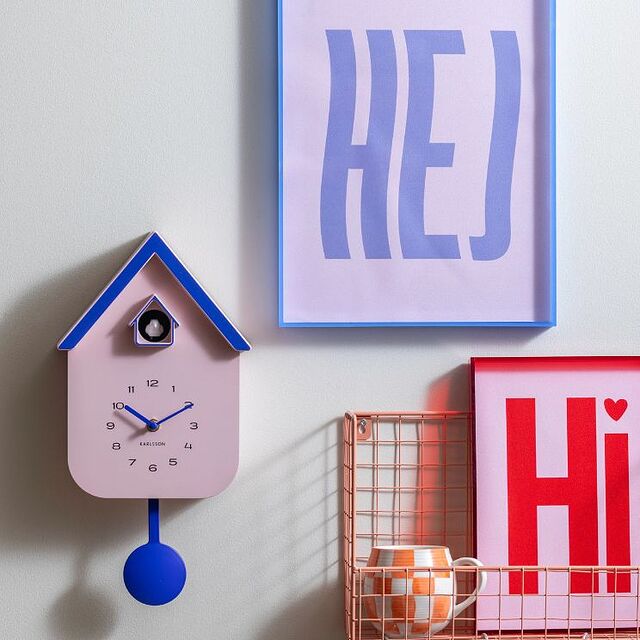
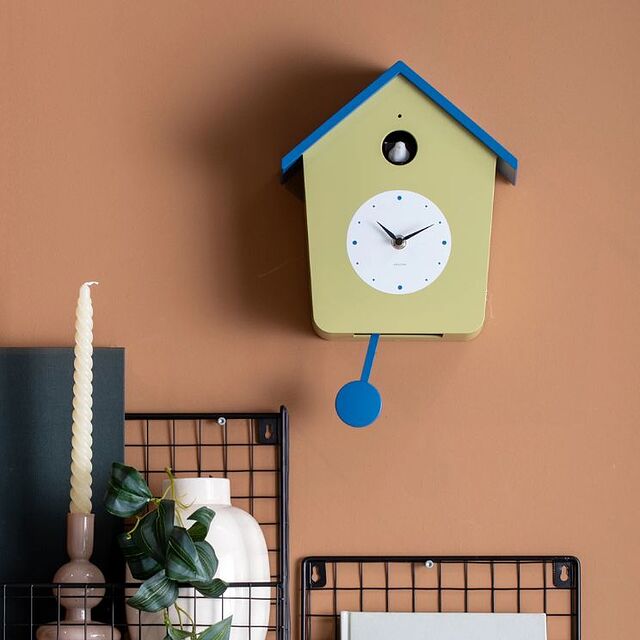
4. Cuckoo Light wall clock – a classic with a modern twist
A Karlsson model inspired by classic design, but in a light, minimalist polystyrene form. An alternative to the richly carved, old clocks produced in the past.
Advantages:
- Illuminated bird popping out on the hour
- Clear dial with sharp contrast
- Ultra-quiet mechanism (no ticking)
- Sweep second hand
- Pendulum mechanism as a decorative design element
A proposal for a modern living room or a teenager's room – a compromise between a classic known worldwide and minimalist design. Also check out our other pendulum clocks.




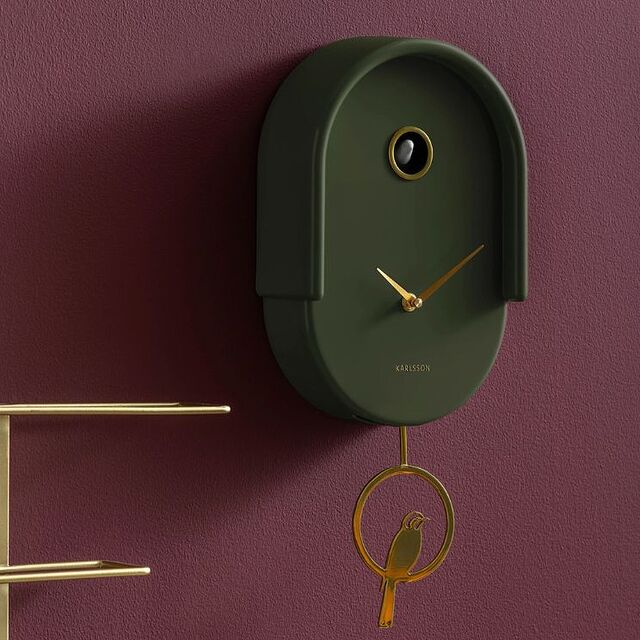
5. Minimalist Esencia Cuckoo clock (Karlsson)
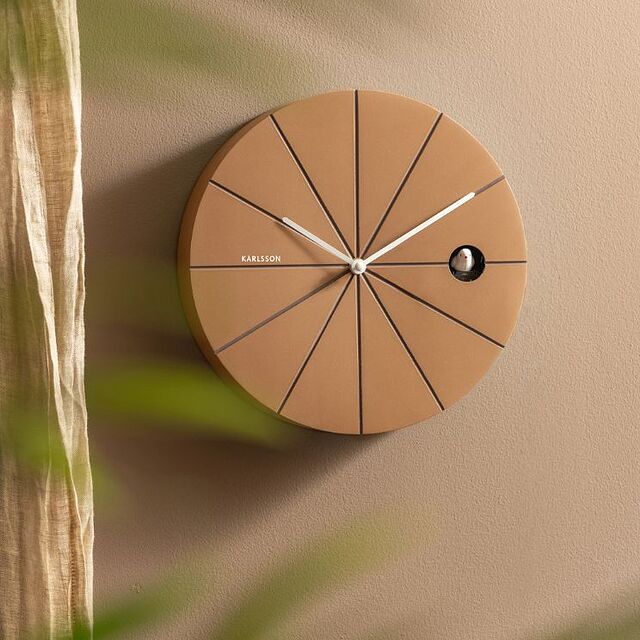
A minimalist form – a round dial with a diameter of 30 cm without numbers, with delicate hands and a small window for the cuckoo. The iron construction gives it an industrial character.
Characteristics:
- Gold details (hands, border) adding a touch of luxury
- Ultra-quiet mechanism powered by an AA battery
- Amount of decoration kept to a minimum
- Style: loft, modern, glamour-minimal
For everyone looking for a "clean" form, where the clock will not dominate an orderly interior. A great choice for an elegant office or dining room.


A clock with... a surprise
And for all those who are looking for a discreet reminder of the passing hours, but do not like the cuckoo and its traditional sound, and prefer other animals to birds, the Karlsson brand proposes a modern interpretation of the Black Forest design - a clock with... a dog! A perfect gift idea for a teenager's room or a funny gadget for a fan of four-legged friends, a veterinarian, or a behaviorist. Who dares?


Cuckoo alarm clock
If, on the other hand, you do not want to hang a clock on the wall and are looking for something to decorate a fireplace, bedside table, or library shelf, you can also opt for a cuckoo alarm clock, which can easily serve as a modern table clock. Some of them are equipped with an LED display, which additionally gives them a modern character.


Practical tips on how to care for a cuckoo clock:
How to care for a cuckoo clock so that it serves you for years?
Cuckoo clocks should be properly mounted on the wall to avoid operational disruptions – they should not be turned upside down.
To ensure proper operation, regularly take care of cleanliness, removing dust from the mechanism and the casing.
Most cuckoo clocks require periodic winding of the mechanism, which usually takes place every 4 to 8 days, depending on the model. The most classic mechanism in cuckoo clocks is the weight-driven mechanism, which uses gravity to power the clock.
Summary: which cuckoo clock to choose?
A cuckoo clock is a combination of tradition dating back to the 17th century with modern design and functionality. From the first mechanical clocks from the Black Forest to today's models with a light sensor – most solutions combine nostalgia with convenience of use.
A simple way to choose:
- Determine the style of the interior (vintage, minimalist, colorful)
- Choose the type of mechanism (mechanical requires winding, quartz – does not)
- Adjust the volume to your lifestyle (light sensor, switch)
All described cuckoo clocks are available in our offer. Whether you are looking for a colorful accent for the kitchen or a minimalist clock for the office or living room, you will find a model here that meets your expectations, combining tradition with modernity.
Looking for a kitchen clock? Check out our guide to choosing the perfect kitchen clock here.