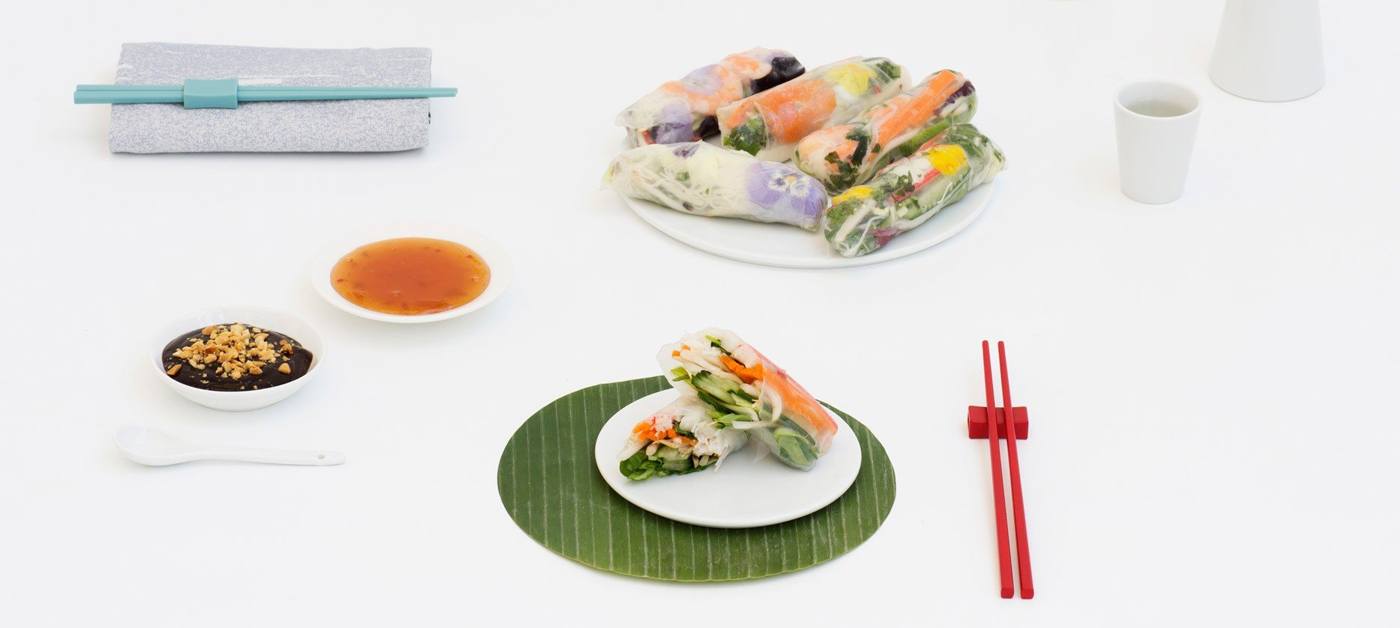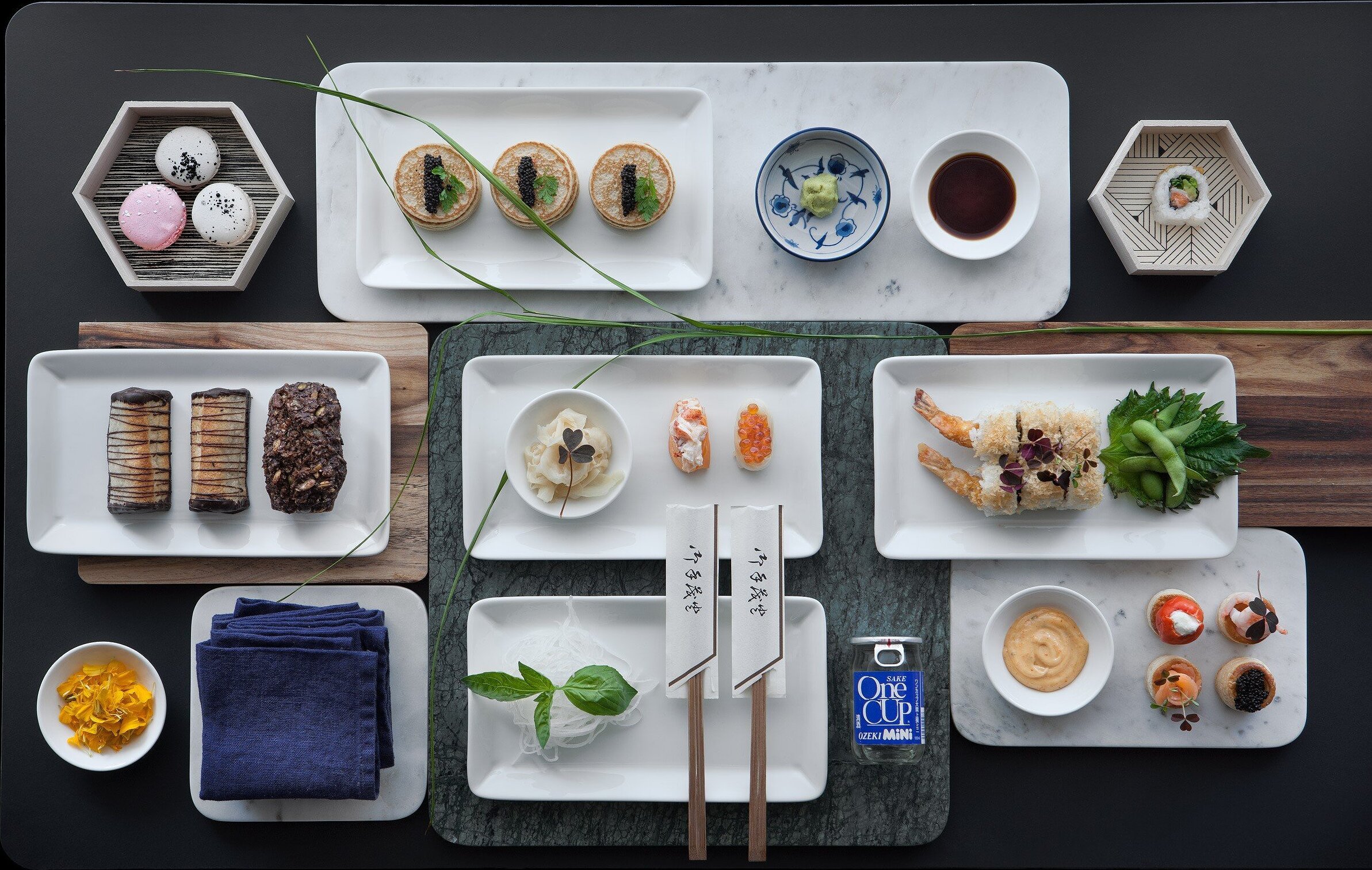
Sushi - it delights in its form and aesthetics of serving, it is healthy, light and, most importantly, exceptionally tasty. Unfortunately, regular visits to a restaurant, despite the excitement of the culinary experience, can have a significant impact on the wallet. Fortunately, sushi can also be easily prepared at home without any sophisticated cooking skills. All it takes is enthusiasm and a little knowledge to bring the traditional Japanese ritual into your own home.
Japan is not only the Land of the Blossoming Cherry, but the world-famous land of rice, whose shores are lapped by waters full of fishing grounds, including salmon and crustaceans. Although in the country on the Vistula, rapeseed and wheat dominate the fields, and the most popular seafood in the Baltic Sea is instead herring, Poles have grown fond of one of the flagship dishes of Japanese cuisine. If you too belong to the group of sushi lovers, you have come to the right place. Today we will tell you what you need to make sushi at home and how to prepare it step by step. You will be surprised how easy it is!
Where to eat good sushi?
The best sushi place in town is hidden in your home!
3 reasons why sushi prepared at home tastes better
- Preparing sushi is great fun. Sushi is trendy. Cooking together with friends becomes not only a way of satisfying hunger but great fun. Preparing sushi together is also perfect for two during a romantic date at home. In this way, the pleasure of eating sushi can even last for several hours.
- Authentic Japanese cuisine - prepare sushi just the way you like it. By preparing sushi at home, you can be sure that the products you use are fresh. You can also use the ingredients you like best. Sushi with smoked catfish, peppers or mushrooms? Why not!
- Sushi served in restaurants is expensive. The high price of sushi is well known to those who love its taste and often indulge themselves. The high price of sushi is mainly due to the costs that restaurants incur to purchase fresh fish. Cheaper sets offered in less well-known establishments raise the suspicion that the dish served may be of poor quality or even harmful to health. By cooking in your own home, you have the chance to significantly reduce the price of sushi so that the high bill does not spoil anyone's appetite.
Our tip

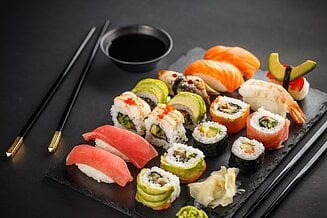
Everything you need to start preparing sushi in your own home
Sushi is an exquisite and elegant dish, the taste of which is determined by the details. Therefore, the preparation of sushi should begin with shopping. The cost of the products needed to prepare sushi can be high, but it is important to remember that these will largely be reusable ingredients. And compared to visits to a restaurant, the investment will quickly pay for itself.
What is needed to make sushi at home?
- Sushi rice
Rice is the basic ingredient for successful sushi, and the ways to prepare it may vary from recipe to recipe, but there are a few rules that absolutely must be followed. How do you prepare rice for sushi? Firstly, we choose rice... for sushi - this is important because its unique texture and flavour make it impossible to use any other rice used in Asian cuisine. Secondly, we do not combine two different types of rice. One of the most commonly used types of rice in Poland is Shinode. You should look for good quality rice in oriental food shops. Thirdly, well-prepared rice should be sticky, but not overcooked or mushy. Ideally, you should have a special pot for cooking rice for sushi; if you don't have one, you should strictly follow the recipe.
- rice vinegar
Rice vinegar is used to make a sushi dressing. It allows the rice, unsalted during cooking, to develop flavour and, most importantly, its consistency allows rolls and balls to be formed. In emergency situations, you can try replacing it with wine or apple cider vinegar, but this is not recommended. Sushi is a dish whose taste is very easy to spoil, and using inappropriate ingredients is the easiest way to culinary failure.
- wasabi
The Japanese equivalent of traditional horseradish. However, it should not be regarded as a substitute. Wasabi is available in a tube or as a powder, ready to use after dissolving in water.
- soy sauce
A good quality soy sauce should contain only natural ingredients. When served with sushi, it gives it a more distinctive character. It has a salty aftertaste and goes well with wasabi. If you don't have a set of special sushi dishes, serve it in small bowls or salad bowls - they work just as well!

- nori
Nori, or seaweed, is available in different quality grades: from green and red, through silver and gold, to diamond. The former are the cheapest, but not necessarily the worst. They will work perfectly in the hands of a beginner, making it easier for them to form the rolls. Nori likes to be moist, so it is important to store them airtight, especially if you buy a larger pack.
- bamboo mat
It is not the rolling of the sushi that is difficult, it is the lack of a suitable mat that makes it unfeasible. Traditionally, bamboo mats are used to prepare sushi, but a modern and very practical solution is silicone mats, which are less sticky and much easier to keep clean.
- sushi knives
Preparing sushi is an art. Just as a painter needs a paintbrush, a sushi master, even one who makes sushi at home, should necessarily have a sushi knife. Made from high-grade carbon steel, a Japanese sushi knife is more expensive than traditional European knives, but it is an investment in quality for years to come. Each knife has a different, strictly defined purpose: for filleting, slicing fish, and shredding vegetables. A knife with a narrow, elongated blade, for example, is ideal for thinly slicing meat and fish, while the cleaver-like Nakiri knives are the perfect choice for slicing both hard and soft vegetables. Japanese knives should be found in the kitchen of every cooking enthusiast, not only in the context of preparing sushi. These knives are characterised above all by their hardness, sharpness, abrasion resistance and precision, thanks to which slicing becomes really fast and the shredded pieces of meat, fish or vegetables are perfectly even.
- chopsticks
They come in metal, wood or plastic, your choice depending on your personal preferences. It is a good idea to get chopsticks with a stand so that you can neatly put them away while eating. They can be purchased in sushi accessory sets or as a stand-alone product.
How to make sushi at home? Step-by-step recipes
For the novice lover of Japanese cuisine, the world of sushi can seem quite intimidating. In particular, all those strange-sounding names that say little to the amateur. In order to easily find your way around any sushi restaurant and learn ways to prepare sushi at home, all you need to do is learn the Japanese language... Or you can take a look at our guide.
The most popular types of sushi:
1. maki
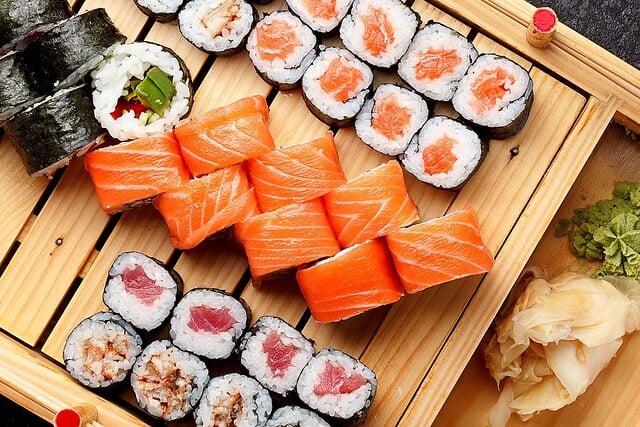
When we think of sushi, we usually think of maki. It is the most popular type of sushi in Europe. Maki is simply rice with ingredients wrapped in nori. The resulting roll is divided into smaller strips. Please note that maki is eaten whole, 1 slice means 1 bite!
Depending on the number of ingredients and how they are wrapped, maki can be divided into:
- hosomaki
Maki with one ingredient. In Japan, these are referred to as 'gu' and each has its own distinct name. In this way, we distinguish, for example, between sake maki, which is maki filled with salmon, and tekkamaki - maki with tuna.
- futomaki
These are so-called thick rolls. They are larger than hosomaki because they are made with a minimum of 4 ingredients. A version for the more advanced.
- uramaki
When preparing uramaki, we swap the order. So-called inverted maki are surrounded on the outside by rice, which is usually topped with sesame seeds. Inside such a roll is gu, e.g. salmon or tuna, additionally wrapped with nori.
2 Nigiri
While a European will opt to prepare maki, a Japanese will rather choose nigiri. This is a hand-formed spherical or oblong portion of rice on which a specific side dish is placed. The most common choices are pieces of raw or smoked salmon or seafood. Depending on the ingredients, we can encounter, among others:
- akami
A type of nigiri most often served with tuna. In Japanese, the expression 'akami' translates as red meat.
- shiromi
Shiromi is prepared with white meat fish. We eat it with cod, for example.
- nimono
A nigiri is called nimono if the additional ingredient has been pre-cooked. This will be the case with seafood, for example.

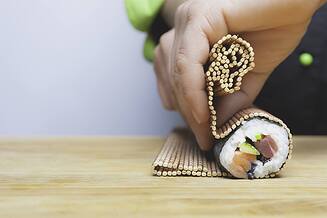
Salmon sushi - a simple recipe for beginners
Ingredients:
1 cup sushi rice
6 tablespoons of vinegar
2 tablespoons sugar
1 teaspoon salt
wasabi
200 g cold smoked salmon
nori (approximately 5 slices)
Remember that sushi is served with soy sauce, wasabi and pieces of pickled ginger.
Step 1
Cook the rice
Rinse the rice before cooking. To do this, pour it into a bowl and pour running water over it. Stir and pour off the water. Repeat until the water is clear. Once you have finished rinsing, leave the rice in the water for about 20-30 minutes. You can use the free time to make a mortar for the rice. Pour the rice vinegar into a pot, and add the sugar. Heat the mortar over low heat, stirring gently. Leave the finished mortar to cool. Then return to the rice, drain and pour in fresh water at a ratio of 1 cup of water to 1 cup of rice. Bring the rice to a boil, then reduce the gas and leave for 13 minutes. Turn off the gas and leave the rice to simmer for another quarter of an hour. Keep the rice covered throughout the cooking time. Turn the cooked rice out into a bowl and pour over the dressing.
Step 2
Prepare your favourite toppings
Our sushi comes with slices of smoked salmon, but you could just as well use tuna, for example. You can also expand the contents. Pieces of avocado or fresh cucumber go perfectly with the smoked salmon.
Caution.
Step 3
Wrap
Lay out the bamboo mat in front of you and place the nori on it. The mat side of the seaweed should be facing upwards. Spread a thin layer of rice evenly over the nori surface, leaving some space around the edges. Arrange a slice of smoked salmon in the middle section. Don't forget the wasabi! You can add a little between the piece of fish and the surface of the rice, or spread it over the edge of the nori. Roll towards the centre, and remember to press the contents down each time as if you were going to seal it.
Warning.
Step 4
Slice
If you have a professional sushi knife at home - success guaranteed. If not, choose the sharpest one. Cut carefully so as not to damage the seaweed. Keep the sushi pieces small so that you can take them in your mouth whole.
Done!
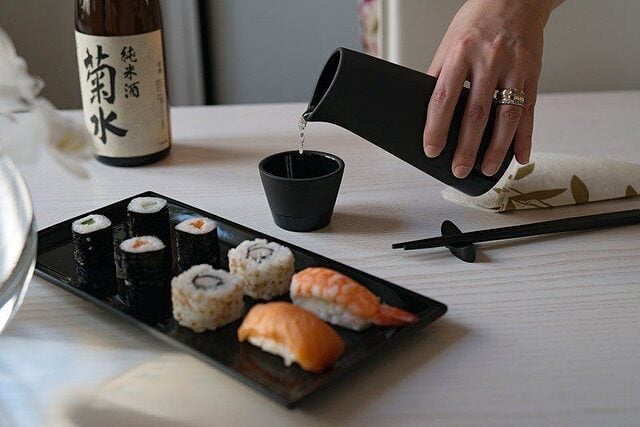
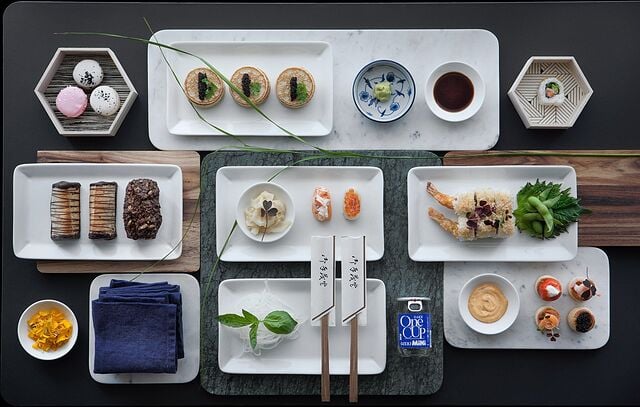
How to eat sushi? Home Etiquette
Sushi is one of those dishes that you are also happy to eat with your eyes. Associated with Japanese tradition, it requires not only proper preparation, but also the observance of rules and standards which will ensure that an evening or afternoon with sushi is not just an ordinary meal, but turns into a real feast for the senses.
Aesthetics of serving - how to serve sushi at home?
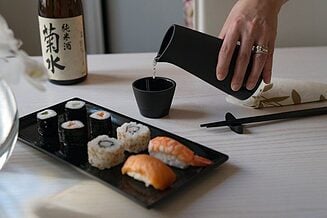
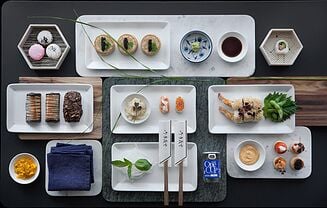
Sushi should be served in a neat and aesthetically pleasing manner. Precisely cut pieces of sushi should be carefully arranged on a board or platter so as not to dirty the space between them. Choose a visually appealing board using our suggestions: Not just for cutting ... 5 ways to use a kitchen board. There should be separate bowls for wasabi and ginger next to the platter. Ingredients such as soy sauce are much cheaper to buy in large containers. However, a large bottle will not look nice on the table. Therefore, if you plan to make friends with traditional Japanese cuisine for the long term, it is worth investing in a professional soy sauce dispenser. Sushi is often served during a romantic evening for two or as part of a gathering with friends. If you want to create the right decoration and atmosphere, it is worth purchasing an original sushi set consisting of a wooden base and matching and sturdy ceramic containers and chopsticks. For the comfort of guests who are inexperienced in eating sushi, instead of chopsticks, it is possible to use convenient tongs.
Tip


Savoir vivre at the table - don't do it!
- Don't force your guests to eat with chopsticks. Sushi is one of the few dishes which should be eaten with the hands.
- Do not bite into the sushi pieces, take them in your mouth whole and savour the full flavour of all the ingredients.
- Do not soak the rice in soy sauce, as it will absorb too much immediately. Dip a piece of fish in it.
- Do not mix the wasabi with the soy sauce, place it directly on the piece of fish.
- Don't treat the ginger as an accompaniment to the sushi pieces, its job is to neutralise the taste between one serving and the next.
- Don't talk too much about how you made your sushi, just get on with eating it. Sushi always tastes best when fresh, just after preparation.
Enjoy!