Choosing the right frying pan might seem straightforward, but the sheer variety of models, materials, and coatings available means it's a decision that requires a moment of thought. In this guide, you'll learn how to match a frying pan to your needs, what types of pans are on the market, and what to look for to pick the best frying pan for your kitchen.
What to Consider When Choosing a Frying Pan
Stovetop Type and Pan Compatibility
Not every frying pan will work on every cooking surface. For those using an induction hob, an induction-compatible frying pan made from a material that reacts to a magnetic field will be essential.
This means the material for an induction hob should be ferromagnetic – steel, cast iron, or specially adapted aluminum. If you're looking for a quick response to temperature changes, a good induction frying pan will be your best bet. It's worth remembering that not every non-stick frying pan will work on induction – always check the manufacturer's markings.
Cooking Frequency and Usage Style
Do you cook frequently, frying vegetables, meats, fish, or pancakes? Or do you cook occasionally and need a versatile solution? Your cooking style directly influences the choice of the right frying pan. Those who value quick, everyday frying should look for non-stick frying pans, especially those with a ceramic coating or PTFE coating.
On the other hand, for frequent frying over high heat or at high temperatures, e.g., for frying meats, stainless steel frying pans or solid cast iron frying pans, which are characterized by damage resistance and longevity, will work wonderfully.
Base Thickness and Pan Size
The thickness of the frying pan's base is also significant – a thicker base means better heat distribution and retention, which is particularly important for pancake pans or dishes requiring even frying. The appropriate size depends on the number of household members and your preferred cooking style. Large grill pans or woks are ideal for families or one-pot meals.
Dishwasher Safe and Damage Resistance
For many, ease of cleaning will also be important. Many modern PTFE-coated frying pans or ceramic-coated frying pans are dishwasher safe. However, not all types of frying pans tolerate such care without losing quality. A non-stick frying pan requires gentle handling – it's best to avoid metal spatulas and harsh detergents.


Types of Frying Pans by Material
Stainless Steel Frying Pan – Durability and High-Temperature Resistance
Stainless steel frying pans, usually made of stainless steel, are synonymous with durability and versatility. They are perfect for frying meats, as well as for preparing dishes that require high temperatures. What's more, they handle dishwasher cleaning well and are resistant to scratches and discoloration.
Although they don't have a natural non-stick coating, over time – with proper seasoning – they can develop a layer that prevents food from sticking. They are ideal for those who expect high-quality equipment that will last for years. Choosing a stainless steel frying pan is an investment in solidity.


Cast Iron Frying Pan – A Classic for Stewing and Baking
A solid cast iron frying pan is a classic that works not only on the stovetop but also in the oven. It's indispensable for long stewing, baking, and high-temperature frying. Cast iron frying pans have an excellent ability to retain heat, ensuring dishes are heated evenly.
It's worth noting that such a durable frying pan can last for generations if properly cared for – seasoned and protected from moisture. For lovers of traditional cuisine and heavier cookware – this is one of the best types of frying pans.


Aluminum Frying Pan – Lightweight and Quick to Heat
Aluminum frying pans are among the most popular and frequently chosen models, especially by those who value lightness and convenience. Aluminum heats up quickly and distributes heat efficiently, making it an excellent choice for fast cooking.
Most aluminum models feature a ceramic, Teflon, or PTFE coating, which significantly enhances their functionality. Ceramic frying pans based on aluminum are a good choice for everyday use, but care must be taken to avoid scratches. Considering an aluminum frying pan is worthwhile, especially if you prioritize low weight and ease of handling.


Copper Frying Pan – Professional Thermal Precision
Though less common in home kitchens, the copper frying pan is an absolute favorite among professional chefs. Copper boasts excellent thermal conductivity, allowing for lightning-fast responses to temperature changes.
Most often, we see them as vessels lined internally with a layer of steel or a ceramic coating, which protects against oxidation. This is a higher-end product, but for demanding users – it can be the best frying pan for controlled frying of delicate ingredients.
Glass Frying Pan – For Allergy Sufferers and Cleanliness Enthusiasts
A glass frying pan is a proposition for people with allergies, sensitivities, and those seeking the most hygienic solutions. Glass does not react with food, does not alter its taste, and is easy to clean.
However, it is not the most common frying pan for frying, as it does not conduct heat as efficiently as other materials. A glass frying pan can be a good choice for reheating or baking in the oven, but its use on the stovetop requires caution and compatibility with the heating surface.
Types of Frying Pans by Coating
Ceramic Frying Pan – Natural and Scratch-Resistant
Ceramic frying pans are gaining increasing popularity due to their properties and aesthetic appeal. The ceramic coating is usually made from natural minerals, which means it does not contain harmful chemical compounds such as PFOA or PFOS. This makes it an excellent choice for those who care about health and the environment.
The ceramic coating is characterized by resistance to scratches and high temperatures. It's a good choice for everyday frying with a small amount of fat. Although it is not as durable as PTFE coatings, with proper use, it can retain its properties for a long time.


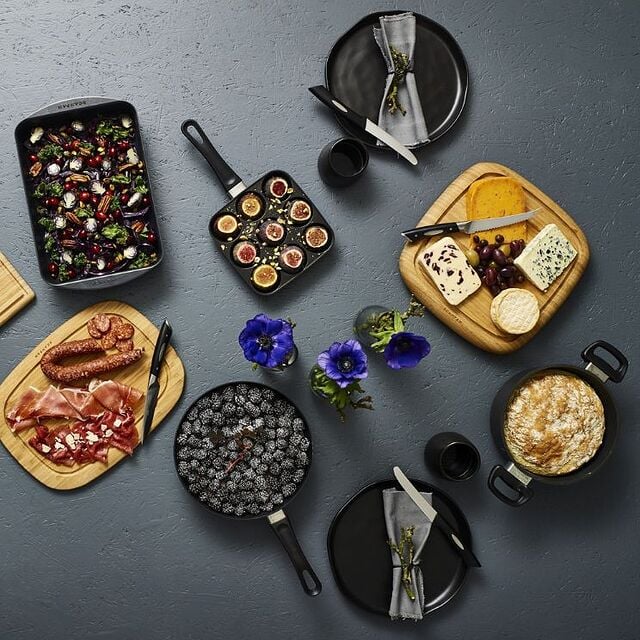


PTFE Coated Frying Pan – Popular, but Requires Caution
PTFE-coated frying pans (polytetrafluoroethylene, commonly known as Teflon) are by far the most popular type of frying pan in home kitchens. The PTFE coating provides very good non-stick properties, preventing food from sticking even with minimal oil.
However, it's important to remember that this type of Teflon frying pan requires careful use – it should not be overheated or used with metal accessories that could damage the surface. Modern PTFE-coated frying pans are PFOA-free, but it's worth choosing models from reputable manufacturers that are also labeled as PFOS-free.
Titanium Frying Pan – Durability and Fat-Free Frying
If exceptional durability and resistance are what you're after, titanium frying pans might be the perfect solution. The titanium coating is very scratch-resistant, and thanks to its non-stick properties, it allows for frying meats and vegetables even without fat.
A fat-free frying pan with a titanium coating is an excellent option for those leading a healthy lifestyle. Although they belong to the more expensive models, choosing the right titanium frying pan can be cost-effective in the long run.
Granite Frying Pan – Aesthetics and Durability in One
Granite frying pans combine aesthetic appeal with functionality. They are usually based on an aluminum body, covered with a granite coating, which exhibits good non-stick properties. Such a pan coating is abrasion-resistant and works similarly to ceramic or Teflon.
A non-stick granite-coated frying pan can be used for frying pancakes, vegetables, or meats without the risk of burning. Granite-coated frying pans are also healthy, free from PFOS and PFOA, and often compatible with induction hobs.
Enamel Frying Pan – Safe for Allergy Sufferers
Enamel frying pans are a good solution for people allergic to metals – the glassy pan coating forms an effective protective barrier that does not react with food. They work well for frying pancakes, stewing, and gentle reheating.
However, they are not recommended for very high temperatures or intense frying. An enamel frying pan is aesthetic and available in many colors, which can be an asset in stylish kitchens.


Specialized Frying Pan Types for Specific Uses
Grill Pan – For Meats and Vegetables with a Grate Effect
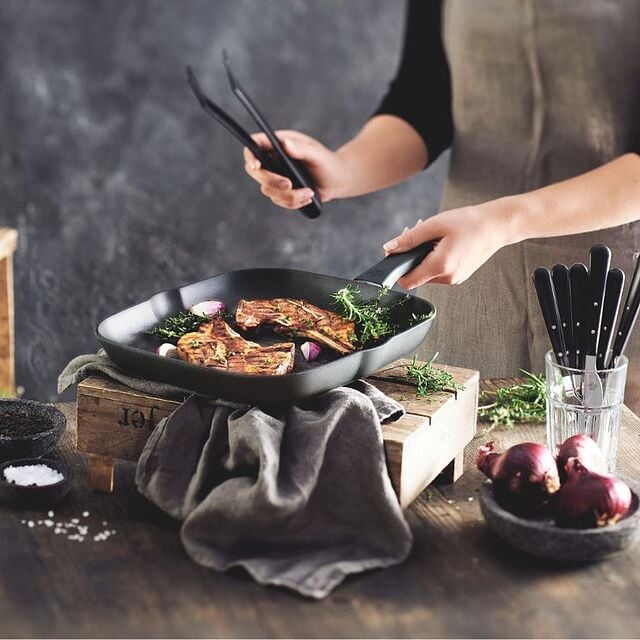
A grill pan is an excellent choice for grilling enthusiasts in a home setting. Thanks to special ridges, it allows excess fat to drain away and creates a characteristic pattern on dishes.
Pros:
- Ideal for frying meats, fish, and vegetables,
- allows for fat-free grilling,
- often made from durable material (cast iron, aluminum),
- great for induction hobs and gas stoves.
Cons:
- quite heavy, which can make maneuvering difficult,
- requires proper care.
This is a fat-free frying pan that can effectively replace a classic grill in the kitchen.


Pancake Pan – Thin Base and Low Sides
A pancake pan is designed with one goal in mind – quick and even pancake frying. It is characterized by its light weight, very shallow sides, and an perfectly smooth non-stick coating.
Pros:
- allows for easy flipping and sliding of pancakes,
- thin base ensures quick heating,
- most often equipped with a Teflon or ceramic coating.
Cons:
- limited use – due to its low sides, it's not well-suited for dishes with a lot of sauce or fat.
This is the best frying pan for breakfast and dessert lovers.


Wok Frying Pan – Ideal for Asian Cuisine
A wok frying pan is a wide vessel with a rounded bottom, perfect for Asian cuisine – for stir-frying, boiling, stewing, and even deep-frying.
Pros:
- allows for quick frying at very high temperatures,
- minimal fat consumption,
- great for large portions of vegetables and noodles
- available as a good induction frying pan, with a flat bottom and ferromagnetic material.
Cons:
- requires a strong heat source – on a standard hob, it may not reach optimal temperature.
- quite cumbersome to store – its large, rounded shape takes up a lot of space.
This is an excellent example of choosing the right frying pan for a specific cuisine and cooking style.


Fat-Free Frying Pan – For Health-Conscious Individuals
Fat-free frying pans are modern cookware with an advanced non-stick coating that allows for frying without added fat. They are particularly appreciated by those on a diet, athletes, and vegans.
Why choose them?
reduce the calorie content of dishes,
feature a titanium, granite, or ceramic coating,
are often PTFE-coated frying pans, but without PFOA and PFOS,
easy to clean and maintain.
A fat-free frying pan is an ideal choice for those who want to cook healthily and conveniently.


Non-Stick Coatings – What You Need to Know
When choosing a frying pan for everyday use, one of the most important aspects is the pan's coating. A well-chosen coating affects not only cooking comfort but also its health safety, ease of cleaning, and the durability of the cookware.
What is a Non-Stick Coating and How Does It Work?
A non-stick coating is a special protective layer that prevents food from sticking to the surface of the pan. Thanks to it, you can:
fry without fat or with minimal amounts,
keep the pan cleaner more easily,
prepare dishes faster without the risk of burning.
The most common types of non-stick coatings are:
PTFE (Teflon) – classic, very popular, effective with proper use,
ceramic – more natural, abrasion-resistant,
granite and titanium – modern and durable composites.
Ceramic vs. PTFE Coating – Properties Comparison
Ceramic coating:
scratch-resistant,
free from PFOA and PFOS,
handles high temperatures well,
natural and ecological.
PTFE (Teflon) coating:
very effective non-stick surface,
light and inexpensive,
requires caution – a damaged Teflon frying pan may lose its properties,
modern models are safe, provided overheating is avoided and wooden or silicone accessories are used.
Which to choose?
For delicate frying and pancakes: Teflon or ceramic.
For allergy sufferers and those avoiding chemicals: ceramic or enamel.
For intensive use: titanium or granite coating.
Titanium and Granite Coating – Durability and Safety
A titanium coating is one of the most durable and resistant available on the market today. It is found in premium products and offers:
high scratch resistance,
long lifespan,
the ability to fry meats without added fat.
A granite coating is an attractive and practical alternative:
combines elegant appearance with functionality,
conducts heat well,
is often used in frying pans for induction hobs.
Both coatings:
are free from PFOA and PFOS,
work well for frequent cooking,
are considered a high-quality frying pan choice.


Seasoning and Maintenance of Frying Pans
Caring for your frying pan isn't just about aesthetics – a well-maintained pan fries better, lasts longer, and is safe for food contact. Depending on the material, it's worth using different maintenance methods.
When and How to Season a Cast Iron or Steel Frying Pan
Cast iron frying pans and steel frying pans (i.e., carbon steel) require regular seasoning – which means creating a protective layer of fat that:
prevents rusting,
creates a natural non-stick coating,
improves the taste of dishes.
How to season:
Wash the pan thoroughly (without detergents if it has already been seasoned).
Dry and heat on the stovetop or in the oven.
Rub a thin layer of oil (e.g., flaxseed, rapeseed) over the entire surface.
Heat for about 1 hour – preferably in the oven at 180–200°C.
Allow to cool, wipe off excess fat.
How often?
New pan: 2–3 times before first use.
Regularly: every few weeks, depending on intensity of use.
How to Care for Non-Stick Coatings
Frying pans with PTFE, ceramic, granite, or titanium coatings require more delicate handling:
Recommendations:
Do not use metal utensils – only wood, silicone, or nylon.
Do not overheat the pan – especially Teflon ones.
Wash by hand or in the dishwasher (according to manufacturer's instructions).
Do not use abrasive detergents or harsh sponges.
Do not use cooking sprays – they can leave residue.
A well-cared-for non-stick frying pan will last for years without losing its properties.


How to Match a Frying Pan to an Induction Hob
Not every frying pan is suitable for use on induction. If you have an induction hob, you need to pay attention to a few key technical aspects.
Technical Requirements – Ferromagnetic Base and Thickness
For a frying pan to work on an induction hob, it must have a ferromagnetic material – one that reacts to a magnetic field. Additionally, the following are important:
frying pan base thickness – the thicker, the better the heat conduction and retention,
perfectly flat surface – ensures maximum heating efficiency,
solid construction, resistant to deformation.
Magnet test: If a regular magnet sticks to the bottom of the pan – it will most likely work on induction.
Best Materials for Induction
For an induction hob, frying pans made of the following are best:
stainless steel – durable, damage-resistant, easy to maintain,
cast iron – heavy, but perfectly stores heat (a solid cast iron frying pan is an excellent choice),
aluminum with a ferromagnetic base – lightweight and quick to heat (ideal for everyday cooking),
titanium and granite frying pans, provided the manufacturer indicates induction compatibility.
A good induction frying pan should be:
marked as "induction ready" or with a spiral symbol,
appropriately heavy and solid,
equipped with a high-quality non-stick coating (e.g., Teflon coating, ceramic coating, granite coating).
If you're looking for the best frying pan for induction, pay attention to:
the material for an induction hob (e.g., steel, cast iron, aluminum with a ferromagnetic base),
the types of frying pans that will be used most often (e.g., wok frying pan, grill pan, fat-free frying pan).


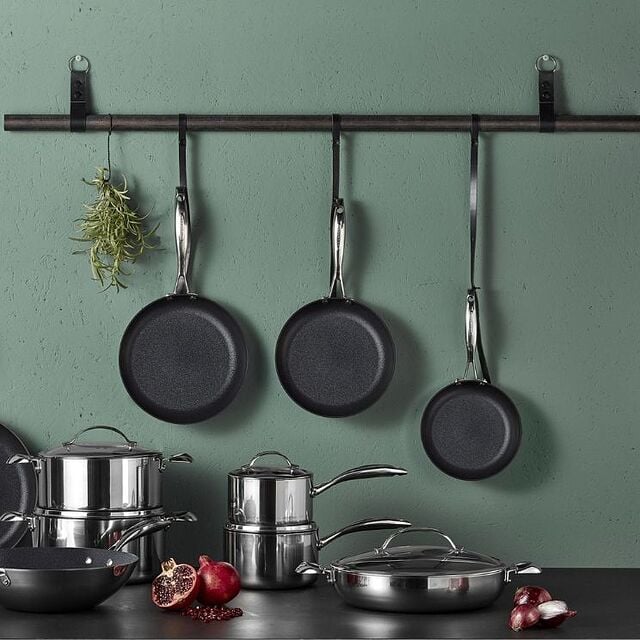


Summary: Which Frying Pan is Worth Choosing?
Choosing the ideal frying pan might seem daunting – but a well-chosen model truly makes cooking easier and improves the quality of your dishes. Luckily, we currently have a huge selection of materials, coatings, and features. The key is to match them to your own needs and stovetop type.
Best Options for Different Needs and Budgets
For everyday use:
Aluminum frying pans with PTFE coating – lightweight, heat up quickly, ideal for daily use.
Good induction frying pan with a thick base and durable coating – for those using induction.
Ceramic frying pans – safe, natural, scratch-resistant.
For demanding cooks and cooking enthusiasts:
Solid cast iron frying pan – for frying, baking, and stewing. Indestructible, but requires seasoning.
Titanium frying pans – for those who value durability and the ability to fry without fat.
Stainless steel frying pans – resistant to high temperatures, great for frying meats and intensive use.
For allergy sufferers or those with sensitivities:
Glass frying pan – neutral, no coatings, easy to keep clean.
Enamel frying pan – safe, hygienic, does not react with food.
For specific applications:
Wok frying pan – for stir-fries, Asian cuisine, quick frying over high heat.
Pancake pan – thin base, low sides, quick heating.
Grill pan – ideal for meats and vegetables with a grate effect.
What to Avoid When Buying a Frying Pan
Not every cheap frying pan is a bargain – it's worth avoiding:
Very lightweight models with thin bases – they can warp.
Unmarked coatings – check if they are free from PFOA and PFOS.
Pans without induction compatibility markings – if you use such a hob.
Models with damaged or peeling coatings – they are unsafe and ineffective.
Low-quality sets – it's better to have one high-quality frying pan than five disposable ones.
In summary: choosing a frying pan should be based on considering your cooking style, stovetop type, health preferences, and budget. With this knowledge, you can consciously choose the best frying pan – and enjoy cooking every day.