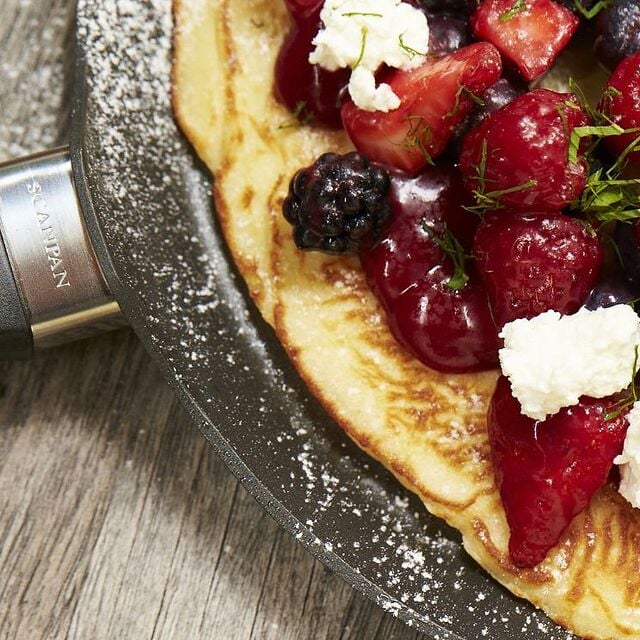
The perfect pancake pan is the key to success if you dream of even, thin, and perfectly browned pancakes. In our guide, we'll tell you what to look for when choosing and which models will work best in your kitchen.
The best pancake pans. Which pancake pan to choose?
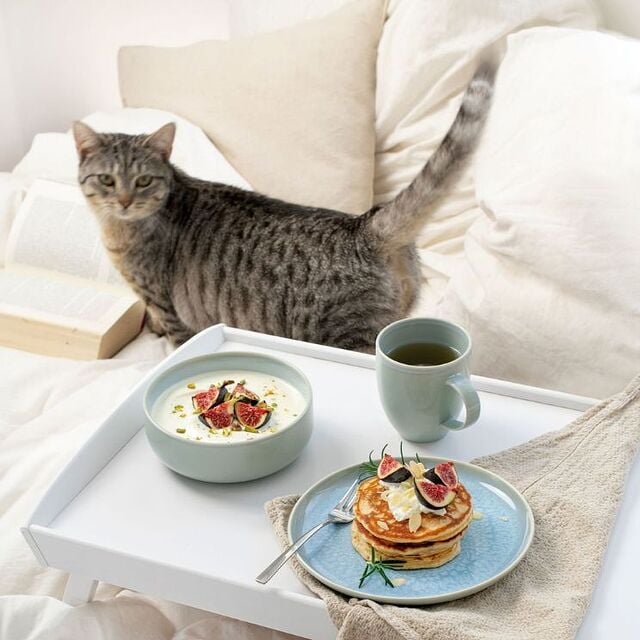
Is there anything more delightful than the aroma of freshly fried pancakes wafting through the kitchen? Warm, thin pancakes, served with your favorite toppings – jam, fruit, chocolate, or even savory with cheese and ham... It's the taste of childhood, joyful moments spent with loved ones, or romantic breakfasts in bed for two. However, for the pancake-making process to be a true pleasure, and not a battle against sticking and burning, the right equipment is key. Today, we'll tell you how to choose the best pancake pan.
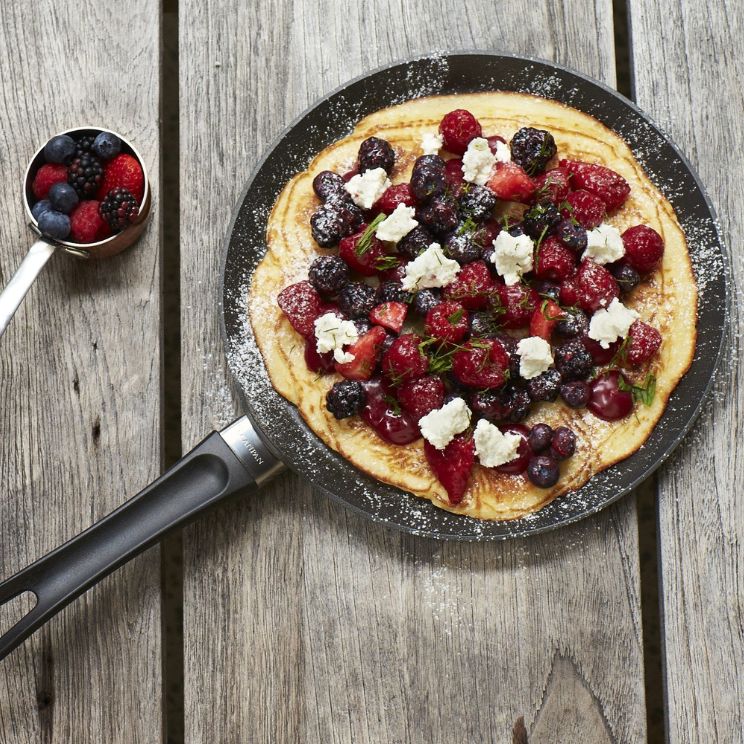


Pancake pan – why is a dedicated one worth it?
You might think: "Why do I need a special pancake pan? I have a regular one." And yes, you can certainly fry pancakes on a standard frying pan. However, a dedicated pancake pan makes the process easier and helps you achieve the thin pancakes you dream of. Plus, the first pancake will never again go to waste or smell of garlic, because a pancake pan will be a weapon that serves you exclusively for preparing this dish.
What characterizes a pancake pan?
Low pan edges: Low pan edges are probably the most important feature. A low rim makes it easier to spread the batter evenly over the entire surface and, crucially, allows you to fry pancakes and flip them by tossing and turning them in the air. And if you're not a master flipper, the low edge will make it easier to lift the pancake with a spatula.
Flat bottom: The shape of a pancake pan is usually an perfectly flat heating surface. This ensures even batter spreading and uniform frying, resulting in thin pancakes.
Appropriate weight: A good pancake pan should be light enough not to be tiring to use, yet heavy enough to retain heat well. Cast iron, for example, excels at maintaining high temperatures, ensuring even thin pancakes are crispy and evenly browned.
As you can see, having a special pan truly makes frying perfect pancakes possible!
The best pancake pans – key features
What should you pay attention to when choosing a pan? Every ranking of the best pans you browse with the thought of frying perfect pancakes highlights these elements:
Non-stick coating: This is fundamental, allowing you to fry pancakes without tearing them. Thanks to it, pancakes don't stick, and the non-stick coating minimizes the need for fat. This type of coating allows you to fry pancakes with a minimal amount of fat.
Bottom thickness: A thick bottom accumulates heat and distributes it evenly. This is a crucial feature when choosing a pan that is meant to guarantee a delicious breakfast.
Pan diameter: Choose a size appropriate for your needs. A large pan will allow you to fry large pancakes, ideal for savory dishes, croquettes, or crepes suzette, which are most often folded into quarters. If you prefer smaller pancakes, the diameter of the pancake pan should reflect that.
Stovetop type: Make sure the pancake pan is compatible with your stove (gas, electric, ceramic, induction). An induction pan is an obvious choice for many people cooking in modern kitchens.
Comfortable pan handle: An ergonomic and cool-to-the-touch handle is a big plus. A comfortable pan handle also matters if you possess that spectacular skill and delight in flipping pancakes in the air.


Types of pan coatings – what to choose?
For those trying to choose a pancake pan, the biggest problem is often not the diameter or design of the pan, but the coating. No wonder. The type of coating used and its quality are of colossal importance for our health, which is why it's always worth taking a closer look at pan markings and whether they contain dangerous PFOA and PFOS compounds.
It's worth remembering that every non-stick coating, regardless of type, has a limited lifespan and may lose its properties over time, especially with improper use (e.g., using metal tools, overheating, washing in a dishwasher, unless the manufacturer recommends otherwise).
Here are the most popular types of pan coatings, their features, pros, and cons:
Pans with ceramic, Teflon, titanium, and ceramic coatings
Teflon pan — what are its advantages?
Advantages:
Teflon coating has excellent non-stick properties,
very easy cleaning,
often an affordable price.
Quickly reaches optimal temperature for frying pancakes with minimal fat.
Disadvantages:
Teflon coating is characterized by lower scratch resistance – requires the use of wooden, nylon, or silicone tools.
Teflon coating is sensitive to high temperatures – heating above 260°C (and especially 300°C) can cause coating degradation and the release of harmful substances. Avoid leaving an empty pan on high heat.
Safety: Modern Teflon pans from reputable manufacturers usually do not contain PFOA (perfluorooctanoic acid), which was used in the past. However, it is important to use them according to instructions and replace them when the coating is damaged or scratched.
Ceramic pancake pan
A ceramic coating is actually a type of non-stick coating based on silica gel (a mineral-derived substance) hardened at high temperatures. It is often promoted as more ecological and healthier (PTFE/PFOA-free) compared to traditional Teflon.
Advantages: Ceramic coating offers a smooth surface and generally good non-stick properties, especially at the beginning of use. Aesthetic appearance, often available in various colors.
Disadvantages: May lose its non-stick properties faster than other coatings with improper use. It is sensitive to overheating (which can destroy it), sudden temperature changes (thermal shock), scratches (though more resistant versions exist), and dishwasher washing (manual washing is recommended). Requires more delicate use and maintenance.
Titanium pancake pan
A "titanium" coating is usually a non-stick coating reinforced with titanium particles or compounds. Its purpose is to increase durability and resistance to damage.
Advantages:
A titanium pancake pan is very durable and significantly more resistant to scratches and abrasion than Teflon or ceramic coatings.
It maintains good non-stick properties for a long time.
Metal tools can often be used on it (though manufacturers still advise caution and avoiding sharp edges).
Allows frying with minimal fat.
Disadvantages:
Usually more expensive than Teflon or ceramic coated pans.
Granite pan for frying pancakes
The term "granite coating" refers to the appearance and often to a coating reinforced with fine mineral particles that are meant to resemble the texture of granite. It is a type of non-stick coating (often multi-layered), designed to improve durability and scratch resistance compared to basic coatings.
Advantages:
Granite coating is often multi-layered, which increases durability and scratch resistance compared to single-type coatings.
Good non-stick properties.
Attractive, often modern appearance.
Usually PFOA/PFOS-free.
Disadvantages:
The quality and actual durability of the coating can vary greatly depending on the manufacturer and specific product line.
Pancake pan with mineral coating:
Mineral-based coatings (e.g., silicon) often form a layer in more complex non-stick coating systems, such as ceramic coatings or some "granite" ones. A mineral coating is less common as the sole non-stick layer.
Advantages:
Natural appearance, often part of more durable and ecological coating systems.
Mineral coating is usually PTFE/PFOA-free.
Disadvantages:
Rarely appears alone as the main non-stick coating.
Its properties largely depend on the other layers and the overall pan manufacturing technology.


Pancake pan - what material?
The body of a pancake pan can be made from various materials, which affect both the heating time of the pan and the time it retains temperature, as well as its weight, durability, and ease of use. The body material is also crucial for compatibility with different types of cooktops.
Let's look at the available options, their advantages and disadvantages:
Aluminum pan for frying pancakes
The most common material for pan bodies, especially those with non-stick coatings. Aluminum is lightweight and an excellent heat conductor.
Advantages: Heats up quickly and evenly, making temperature control easy. Its lightness makes maneuvering the pan (e.g., flipping pancakes) effortless. Usually available at affordable prices. The body is often anodized (to harden the surface) or covered with a non-stick coating.
Disadvantages: Cools down quickly. Not suitable for use without a non-stick coating, as raw aluminum can react with food and is difficult to clean. Without an appropriate ferromagnetic insert in the bottom, it does not work on induction cooktops.
Is a steel pan worth it?
A steel pancake pan can be made of stainless steel or carbon steel. This material conducts heat well, but often requires a thicker bottom (especially for stainless steel) to ensure even heating and heat accumulation.
Types of steel:
Stainless steel: Very durable, corrosion-resistant, does not require seasoning (fat burning). Often used in pans with a thick, multi-layered bottom, compatible with induction. Requires the use of fat for frying to prevent sticking.
Carbon steel: Lighter than cast iron, but heavier than aluminum. Requires regular seasoning (burning thin layers of fat), which creates a natural, non-stick coating that improves over time. Responds very well to temperature changes. Requires proper care to prevent rusting.
Advantages:
Very durable
A steel pancake pan (especially carbon steel, after good seasoning) can develop excellent non-stick properties over time, allowing frying with little fat.
Stainless steel is easy to maintain (though it requires fat for frying).
Disadvantages:
A steel pancake pan heats up slowly (especially stainless steel with a thick bottom).
You cannot fry on a stainless steel pan without fat, and on a carbon steel pan without prior good seasoning. Carbon steel requires specific care (seasoning, avoiding detergents, thorough drying) to maintain the non-stick coating and prevent rusting.
Check out our steel pans offer.
Cast iron pans for pancakes
Cast iron pans are cast from cast iron. They are heavy and heat up very slowly, but once they reach temperature, they accumulate and distribute it evenly over the entire surface.
Advantages:
Extremely durable – a cast iron pancake pan can last for decades, often passed down through generations.
Excellent heat accumulation and retention ensures even frying and perfect browning.
After proper and regular seasoning, cast iron develops a natural, very effective non-stick coating. This is one of the best types of pans for preparing pancakes, and it's also healthy (no artificial coatings).
Disadvantages:
Frying perfect pancakes with this type of pan will have to be left to someone who goes to the gym! Cast iron pans are heavy, which can make maneuvering difficult, especially when flipping pancakes.
Requires regular seasoning and proper care – it doesn't like sudden temperature changes, prolonged soaking, or strong detergents. After washing, it should be immediately dried and possibly oiled to prevent rusting.
Heats up slower.
Here you will find all our cast iron pans.


Induction pancake pan – specifics
If you have an induction hob, choosing an induction pancake pan is not an option, but a necessity. Induction cooktops work on the principle of a magnetic field that induces heat directly in the bottom of the pan, provided it contains ferromagnetic material.
This means that an induction pan must be made of cast iron, stainless steel of appropriate composition, or have a special bottom with a built-in magnetic layer (often found in aluminum pans).
Only such a construction guarantees that the pan will be recognized by the hob and heated effectively. The advantage of frying pancakes on induction, using the right pan, is very fast heating and precise temperature control, which is crucial for achieving perfectly thin and evenly fried pancakes.
Regardless of the type of non-stick coating (Teflon, ceramic, titanium, etc.), the magnetic bottom is key for induction compatibility.
Optimal pancake pan diameter
What pan diameter will be best? A standard pancake pan usually ranges from 24 to 28 cm. This size is universal for traditional Polish or French pancakes (crepes).
Pancake pan sizes
Smaller pan sizes (e.g., 18-20 cm) are good for small portions or when frying for one person, as well as for smaller, thicker pancakes.
A large pan (30 cm and more) will come in handy if you often make large quantities of pancakes or prefer very large, thin crepes that are easier to fold into quarters.
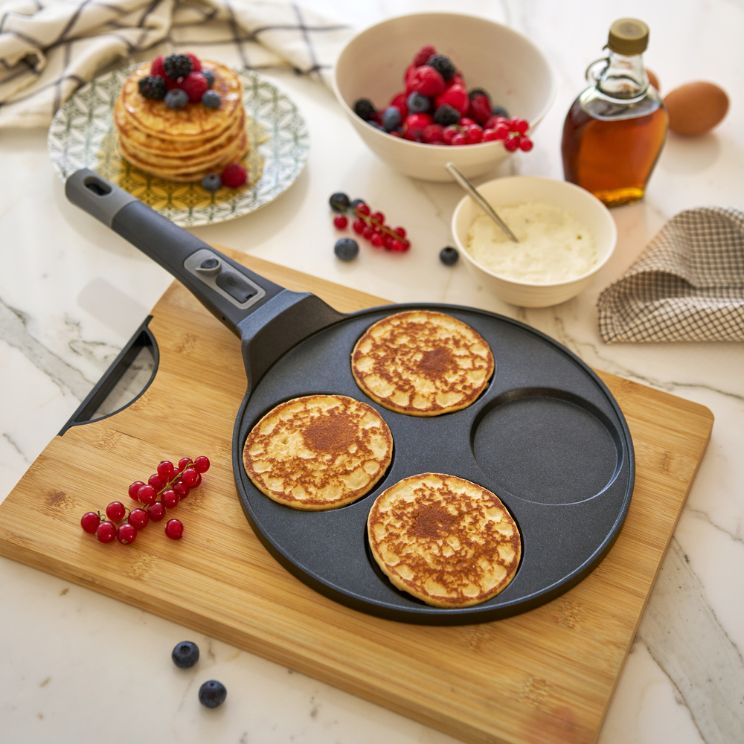
There is also a special pan for mini pancakes, often with indentations, ideal for Dutch poffertjes or American pancakes.
The diameter of a pancake pan is a matter of personal preference and portion size.
Additional features of pancake pans
Some pancake pans offer additional conveniences:
Pan with a detachable handle: Facilitates storage and allows the pan to be used in the oven (if the body allows and it complies with the manufacturer's instructions), e.g., for baking pancakes.
Pancake pan set with accessories: You can often buy a pan in a set with a batter spreader (typical for French crepes) or a silicone spatula for flipping. Sometimes a pancake batter shaker is included. This is an interesting gift idea for pancake lovers.


The best pancake pan for you – summary
Choosing the best pan depends on your needs and preferences:
If you value convenience, easy cleaning, and minimal fat use: Opt for a Teflon pan or one with a good titanium/granite coating. Remember to use gentle tools and avoid overheating.
If you're looking for a Teflon alternative (PTFE/PFOA-free): Consider a ceramic pancake pan or a granite pan. Keep in mind, however, that they may require more delicate care and are more sensitive to overheating or scratches than reinforced coatings.
If you want a pan for years that will develop a natural non-stick coating over time, are willing to invest in its care, and don't mind the extra weight: Choose a cast iron pancake pan or a carbon steel pan (e.g., De Buyer). This requires more attention to maintenance (seasoning, drying).
Check stovetop compatibility: If you have induction, make sure the chosen pan is an induction pan.
Choose the size: Think about how big you like your pancakes and for how many people you usually fry.
Contrary to popular belief, there is no single ranking of the best pans, because the best pan is the one that best allows you to fry pancakes effortlessly, meets your individual needs, budget, and usage style. Investing in a high-quality pancake pan will definitely pay off and make pancake breakfast or brunch a pure pleasure.
A good pancake pan – now you know what to look for!
Choosing the right pancake pan is an investment in kitchen comfort and a guarantee that frying perfect pancakes will become easier and more enjoyable. We hope our guide helps you choose a pan that will be perfectly suited to your kitchen and your needs.
Now that you know everything, only one thing remains: choose your ideal pan, stock up on your favorite ingredients, and enjoy the magical time spent preparing pancakes – whether alone or in the company of those you love. Bon appétit!